
“Nothing like the battle of Omdurman will ever be seen again. It was the last link in the long chain of those spectacular conflicts whose vivid and majestic splendour has done so much to invest war with glamour.” - Winston Churchill, My Early Life
The battle of Omdurman would more rightly be called a slaughter. The British military had essentially the only weapons that mattered, including rifles with repeater mechanisms, gunboats and so-called dumdum bullets that exploded on impact, bullets that were illegal to use in wars between “civilized” states.
In September of 1898, a 23-year old Churchill was among the British forces that massacred some 12,000 Mahdists in Sudan. Another 13,000 were wounded and 5,000 taken prisoner. 47 men on the British side were killed. 382 were wounded.
Churchill would in the same book refer to these kind of battles as “a sporting element in a splendid game.”
Unfortunately, Churchill wasn’t just a racist asshole. He was also wrong. These “spectacular conflicts” where a racist military exterminates thousands of people for the sake of some lebensraum and the mythologized inferiority of the target would indeed happen again. It would be seen again and again.
In his book Exterminate All the Brutes, Sven Lindqvist brilliantly and horrifically contextualized Hitler’s genocide against the backdrop of Europe’s violent and terroristic colonization of Africa, aka that “splendid game”:
“The air he and all other Western people in his childhood breathed was soaked in the conviction that imperialism is a biologically necessary process, which, according to the laws of nature, leads to the inevitable destruction of the lower races. It was a conviction which had already cost millions of human lives before Hitler provided his highly personal application.”
Or, to put it more succinctly…
“Auschwitz was the modern industrial application of a policy of extermination on which European world domination had long since rested.”
I can’t help but wonder what Sven Lindqvist would have to say about Gaza…
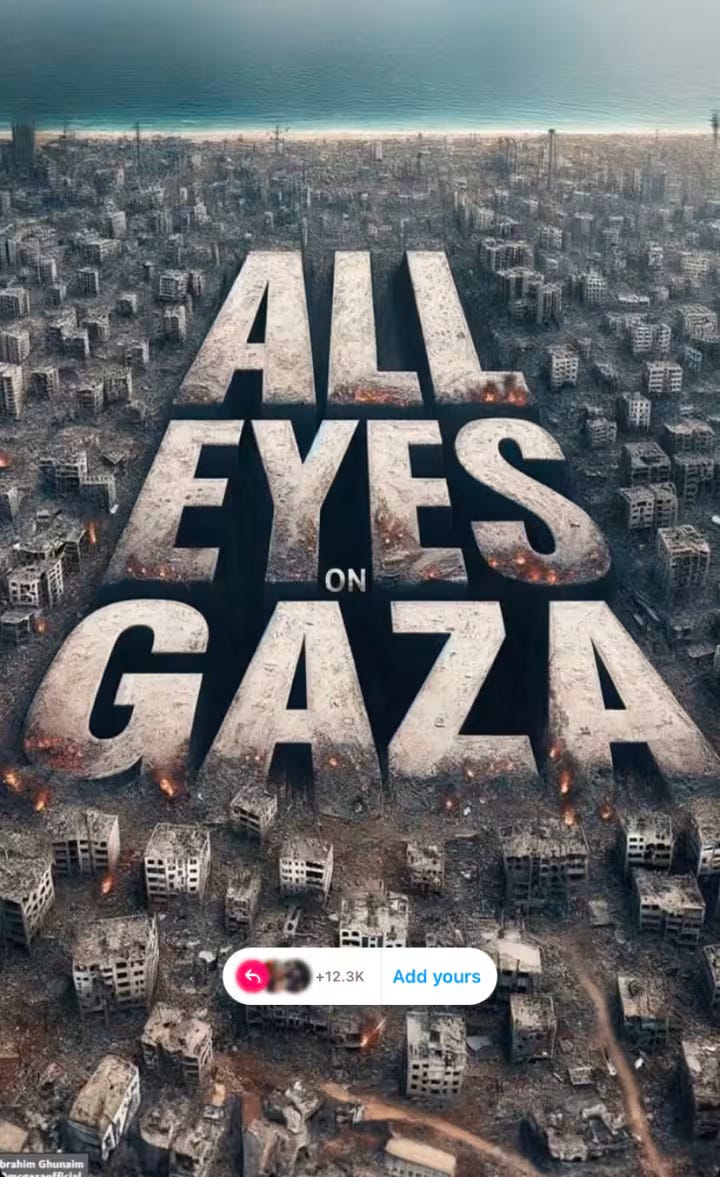
All Eyes on Gaza
what an odd thing to say
to frame a colonialist gaze
for a passive malaise
In a beautiful essay on the role of the witness, Sarah Aziza wrote in Jewish Currents back in January of 2024,
Perhaps the fundamental work of witness is the act of faith—an ethical and imaginative leap beyond what we can see. It is a sober reverence of, and a commitment to fight for, the always-unknowable other. This commitment does not require constant stoking by grisly, tragic reports.
Rather than a feeling, witness is a position. It insists on embodiment, on sacrifice, mourning and resisting what is seen. The world after genocide must not, cannot, be the same. The witness is the one who holds the line of reality, identifying and refusing the lie of normalcy. Broken by what we see, we become rupture incarnate.
We see the battle of Omdurman over and over again, of Auschwitz. We see the repeatable horrors of genocide in ways that previous generations could only access through glorified newspaper sketches and the grotesque stories of the victors who came back to tell of them proudly, medals adorning their necks.
This is a new frontier of removal and engagement. At a time when we can so easily access such images of absolute devastation, we can easily conflate watching a video and sharing it with actually acting.
Back in 2020 when footage of George Floyd’s murder spattered across the internet, I didn’t watch it. A black organizer friend in DC told me they weren’t going to watch it either. “I don’t need to see another black body brutalized. I know what the system is. I’m not who needs to see that.”
The people who need to see the images and reports by the remarkable journalists of Gaza aren’t the ones seeing it. And the ones who make the decisions to send more bombs have already seen it. And they, like Churchill, find it to be a splendid game. In a recent Project Censored interview with Esra’a al Shafei from Surveillance Watch, she explains to me that the companies who make the tech profiting off of genocide quite literally use that genocide as a marketing tool. They’ve seen. They know. They don’t care. The ones who aren’t seeing it are kept comfortably outside the role of witness vis a vis social media filter bubbles and the monstrous work of corporate media in parroting Israeli propaganda, and silencing and covering-up the realities of life and death in Gaza.
So then, what are we saying when we post those videos to our echo chambers? What are we saying when we shout “All Eyes on Gaza” to a system that is very much watching Gaza - after all, it’s the most surveilled place on the planet. What is it to watch a genocide in a system that gamifies terrorism? Furthermore, what are we then asking of the afflicted?
As my friend and Deir al-Balah doctor Khalil Khalidy noted in a Project Censored interview last year, an expectation for Palestinians to not only show their despair publicly, but perhaps more so to show their resiliency has arisen from social media’s constant watchful gaze. Rather than pushing people to act, these videos can have the opposite effect, normalizing the genocide as something resilient Palestinians are fine with. They distort the story as a salve for the viewer rather than a dispatch from hell. They ironically uphold the twisted colonialist trope that the colonized are sub-human in intelligence and empathy while being superhuman in their ability to withstand pain and suffering.
And here’s the thing, I’m not suggesting that we look away either. This is where the nuance comes in - those who know me and my podcast Radical Nuance, know the liminal space is where you can most often find me. But as Sarah Aziza writes, being a witness isn’t just about seeing something, or indeed needing to see new horrors over and over again. It’s an active role that requires us to do more than just watch, and to demand more from the world than having them watch too. After all, there are many people who have seen horrors - from Churchill to Palestinian journalist Bisan Owda to Zionists who mock the despair of their victims. Clearly, watching a genocide is not indicative of which side you are on. A lot of people have their eyes on Gaza - me and you, Netanyahu...
Our analysis and our proceeding actions are what separate us from the colonialist voyeur. It’s the analysis that sees the depravity of our leaders and recognizes the purposefully constructed filter bubbles which keep information away from those who would also become active witnesses. Our role is therefore to get information to those who aren’t seeing it but could be active witnesses (like there’s gotta be some hackers out there who can get Gaza journalist’s work onto CNN primetime, right?!) It is a role that does not ask leaders to watch, assuming they are unaware, good-hearted but unaware. No, they’re very aware. We must not ask them to watch, or really ask of them anything. We must demand. As I’ve written before, this can look a lot of different ways but it is never passive. It is not a cleverly worded sign or a petition or an appeal to authority.
Our role is to be creative in our tactics and our imaginings of emergent futures that aren’t soaked in the blood of genocide. This means being, as Aziza writes, “rupture incarnate,” accepting the gross discomfort of our role as witness, acknowledging the necessity of acting in the present based on our understandings of the past, and our radical hope for the future.
In Exterminate All the Brutes, Lindqvist prophetically wrote,
“We do not want to remember. We want genocide to have begun and ended with Nazism. That is what is most comforting.”
In an interview several years ago with the brilliant Indigenous anarchist Klee Benally, he told me “I have the kind of hope that burns cop cars.” This is the kind of hope we must embody, the kind of witnesses we must be. A passive malaise from a colonialist gaze is our perverse birthright as children of empire. The question is, will we embody that and perpetuate these horrors, or will we do far more than turning our eyes to Gaza, and struggle to ensure that the world after genocide will be, this time, not the same?